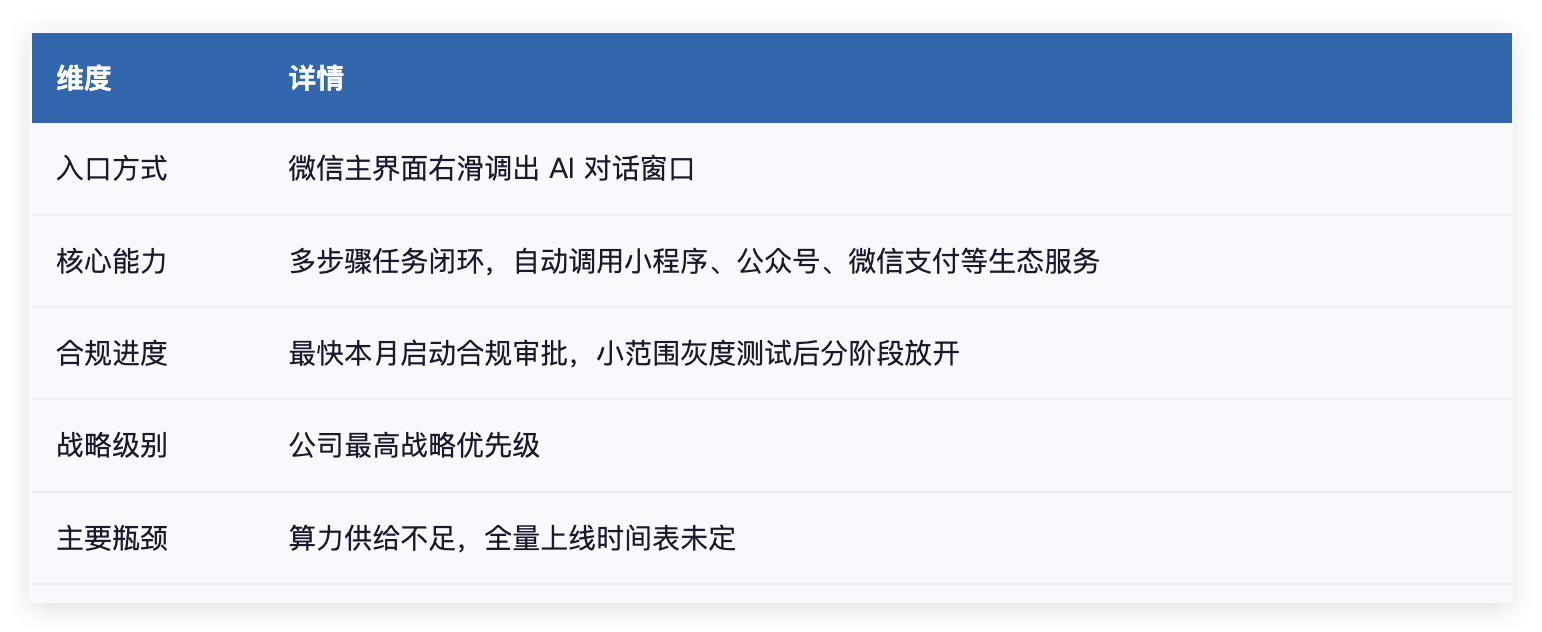
Yesterday (June 2), the Financial Times broke a story: Tencent is testing an AI agent embedded within WeChat, with the project listed as a top strategic priority for the company. By swiping right on the main interface of WeChat, users can bring up an AI conversation window that automatically calls mini-programs to help you complete various tasks—ordering coffee, hailing a ride, checking orders.
On the same day, the Wuhan municipal government press conference announced: striving for the software industry scale to exceed 800 billion yuan during the "15th Five-Year Plan" period, cultivating 150 excellent industry intelligent agent products in 2026, and guiding 100 software enterprises to transform into AI application service providers.
These two things, when viewed together, point to the same trend: AI agents are moving from internal enterprise tools to external service gateways. For businesses, this means the way you interact with customers may soon change.
WeChat AI Agent: The "Super Gateway" for 1.4 Billion Users
According to FT's report and cross-verification from multiple sources, several core pieces of information about WeChat's AI agent have become relatively clear:

The essence of this product is not "adding a ChatGPT inside WeChat," but turning the AI agent into an intelligent execution layer that connects the entire WeChat ecosystem. Previously, users actively searched for services—opening mini-programs, finding stores, and placing orders. With the AI agent, users only need to say, "Help me order an American coffee, less ice, within 30 yuan," and the agent will automatically invoke the coffee mini-program to complete the selection and ordering process.
What is the direct impact on businesses? The meticulously designed official account menus, mini-program homepages, and customer service scripts within the WeChat ecosystem may all need to make way for AI agents in the future. Users will no longer need to "browse" your mini-program but will instead directly "use" your services through AI agents.
Think from another perspective: if WeChat AI agents truly go live on a large scale, the operational logic for businesses within the WeChat ecosystem will need to be rewritten. SEO becomes "getting AI agents to prioritize recommending your services," and conversion rates become "enabling AI agents to accurately call your API."
Computing power is the only bottleneck
FT's report mentions a practical issue: Large-scale full deployment faces the challenge of insufficient computing power supply. WeChat has 1.4 billion monthly active users, and even if only 10% of them use an AI agent once a day, that would be 140 million daily calls. Based on current large model inference costs, this is no small amount.
But this precisely illustrates one thing: Tencent's investment in computing infrastructure is still in a catch-up phase. What was also disclosed yesterday is that the official release date of WeChat's AI agent has not yet been determined—until the computing power issue is resolved, this product can only be rolled out on a small-scale grayscale basis.
For enterprises, this is actually a window of opportunity. Before AI agents become the default entry point for WeChat, there are approximately 6-12 months to adapt your service interfaces, optimize the API call chain of mini-programs, and test user experience in AI agent scenarios.
Wuhan's AI Ambition: 150 Intelligent Agent Products + "Super Software Factory"
Look at Wuhan's policy again. At the press conference on June 2, the Wuhan Municipal Bureau of Economy and Information Technology outlined three directions:
Software product AI cultivation: nurture 150 industry-specific intelligent agent products, build 10 vertical large models, guide 100 software enterprises to transform into AI service providers. Software development AI construction: establish over 10 "super software factories," achieve full coverage of AI-assisted development for 1,000 above-designated-size enterprises, and incubate 100 AI testing tools. Enterprise management AI: the utilization rate of intelligent agents in the software industry's operational management across the city exceeds 80%, covering scenarios such as intelligent office, approval, and operations. Industry target: during the "15th Five-Year Plan" period, the software industry scale will exceed 800 billion yuan, having already reached the 400 billion yuan mark.
There are several numbers worth noting in this: 140,000 software companies, 150 intelligent agent products, 80% usage rate of management-type intelligent agents. This is fully aligned with the direction of the Ministry of Industry and Information Technology's "AI + Software" special action, but the execution granularity has reached specific product quantities and enterprise numbers.
For enterprise digitalization service providers, the signal sent by Wuhan's plan is clear: the government is willing to invest real money to promote the implementation of AI applications. If you are working on AI-powered upgrades for ERP/CRM/OA, cities like Wuhan with supporting policies deserve close attention.
Two clues converge: the entrance has changed, and the base is also changing
WeChat AI agents and Wuhan's AI policies may seem like two separate things, but they point in the same direction: The interactive entry point for enterprise services is being rewritten by AI agents.
WeChat represents the consumer-facing service gateway—1.4 billion users frequently use WeChat in their daily lives. If AI agents become the default interaction method for WeChat, the service outreach logic for all businesses operating within the WeChat ecosystem will need to be adjusted.
Wuhan represents a digital foundation oriented towards enterprise internal operations—by promoting the AI transformation of software products, development processes, and enterprise management through policies, AI evolves from a "nice-to-have" into an "essential capability."
With both sides exerting force simultaneously, the challenges faced by enterprises are twofold:
Internally, your ERP, OA, and financial systems need to integrate AI agent capabilities. Yesterday at Build 2026, Microsoft released the full-stack solution of Scout + Microsoft IQ, while domestic vendors (Kingdee Lingji, Yonyou YonClaw) are also advancing simultaneously.
Externally, your customers may soon use your services through AI agents rather than "opening your app." Is your API AI-friendly? Can your services be accurately understood and invoked by agents?
What should enterprises do now
Based on these two trends, three suggestions for enterprise digital leaders:
First, assess whether your WeChat ecosystem services are "AI-callable". Check whether the core functions of your mini-program have standard API interfaces and whether the service descriptions are sufficiently structured. If the WeChat AI agent needs to "understand" your services before it can call them on behalf of users, your service metadata must be prepared in advance.
Second, focus on cities like Wuhan that have supporting AI policies. If you are upgrading your software products with AI, the 4th Software Innovation and Development Conference in Wuhan on June 10-11 (with over 800 participants including CASIC, CSSC, and Moore Threads) is worth paying attention to. The combination of policy funding and industrial clusters can significantly reduce the cost of AI implementation.
Third, do not separate internal and external AI adoption. Internal agents (management, approval, operations) and external agents (customer service, order processing) must ultimately be integrated. Starting now to plan a unified agent governance framework will be far more cost-effective than waiting for both systems to take shape separately before integrating them.
/Source: Financial Times (FT) report on June 2, press conference of Wuhan Municipal People's Government, TMDM, AIBase, Sina Finance
Disclaimer: This article is compiled based on publicly available information and is for reference only. It does not constitute any investment or procurement advice.