Apple WWDC concluded: Siri revamped, Gemini enters, unavailable in mainland China — three new challenges for enterprise IT

In the early hours of June 9 Beijing time, Apple's WWDC 2026 keynote speech concluded. This was Cook's last WWDC as CEO; he will step down on September 1, with hardware engineering head John Ternus taking over.

But compared to personnel changes, after going through all the published content, I found three things that are directly relevant to corporate IT leaders—and in some ways, more important than new hardware.

First thing: Siri has become a standalone app, running Google Gemini at its core

Apple officially released Siri AI—not an upgrade, but a complete overhaul. A new Siri with a standalone app, cross-app contextual awareness, and visual recognition capabilities. It can understand what you're discussing in Messages, find the corresponding emails in Mail, and then help you create reminders or notes.

The key detail lies beneath the surface: Siri AI's underlying model is powered by Google Gemini. Apple's own Apple Foundation Models were developed in collaboration with Google. Apple's software chief Craig Federighi repeatedly emphasized privacy on stage—"We believe privacy in AI is non-negotiable"—and promised that external experts can verify data usage at any time. But what he didn't make clear is: when an employee's Siri request is packaged and sent to Google's cloud model, how many nodes does the data pass through along the way.

This is not a technical issue, but a compliance issue. If your company has data cross-border review requirements, the reworked Siri on employees' phones is now a new entry point that needs to be included in the scope of data governance.

Second thing: iOS 27 will support free switching of third-party AI models

Although Apple's official press release did not mention it, TechCrunch and multiple tech media outlets have confirmed: iOS 27 has opened up the ability to switch between third-party AI models. When Siri encounters a question it cannot answer, users can seamlessly switch to ChatGPT, Claude, or other third-party models—without leaving the Siri interface.

This design has a greater impact in enterprise scenarios than on the consumer side. In the past, when employees used third-party AI tools, they at least had to actively open a webpage or app—the IT department at least knew this behavior was occurring. Now this switch has been built into the system layer, and employees may not even realize which model they are using.

It's not that this feature is bad. The problem is: whether the enterprise's data classification, DLP policies, and endpoint management strategies can keep up with this change.

Number of Siri AI features available to users in mainland China on iOS 27. Apple officially confirmed: Due to regulatory requirements, Siri AI and new Apple Intelligence features are initially completely unavailable in mainland China.

Third thing: Mainland China is explicitly excluded from Siri AI

Apple phrased it more euphemistically in its press release—"working on regulatory requirements." But what does this mean? It means that for Apple device users in mainland China, the core AI features announced at this WWDC will come with a device that has reduced functionality.

This has two layers of impact on enterprise IT.

The first layer is straightforward: if your company provides iPhones to employees, you can set aside Siri AI-related security policies for now—because it simply can't be used. However, the DMA compliance restrictions in the European market also bring uncertainty—Apple has restricted Siri AI on iOS/iPadOS in the EU region, but it is available on Mac. If you have employees in European branches, policies should be managed separately by device type.

The second layer is more subtle: just because it's unavailable in mainland China doesn't mean employees of mainland Chinese companies won't find ways to use it. VPNs, switching Apple ID regions, sideloading—these things already happened during the previous round of ChatGPT restrictions. By integrating AI functions directly into the system layer, Apple may actually strengthen the motivation to "bypass" usage.

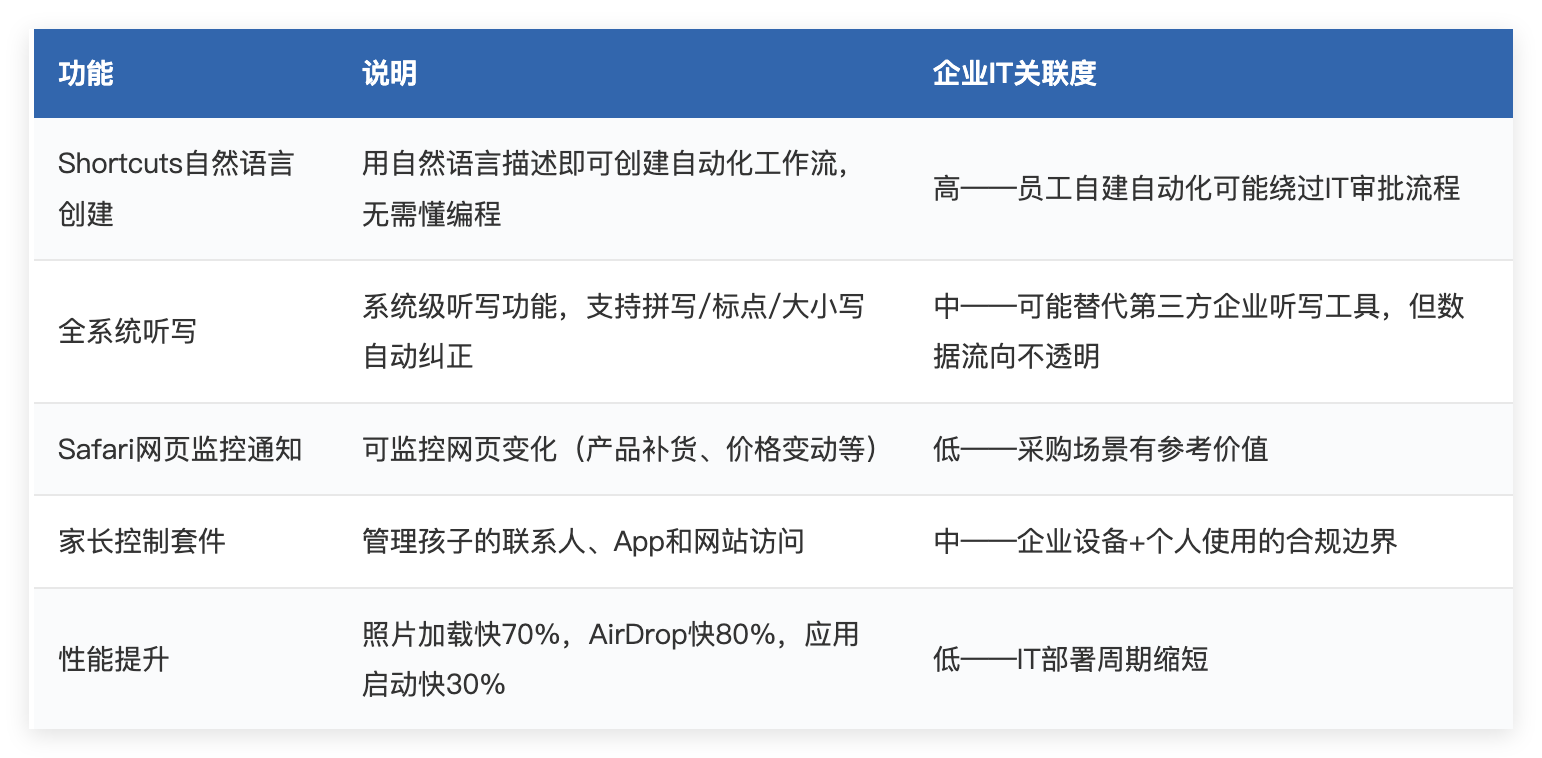
There are a few more details worth noting


Practical advice for CIOs and IT leaders

If you are an enterprise IT manager, there is no need to call an emergency meeting for WWDC. However, there are a few things worth completing in the coming weeks:

First, update terminal security policies.Siri AI is temporarily unavailable in mainland China, but this gives you a time window. Before the official rollout of iOS 27 (this fall), clarify the data flow path of Siri AI — exactly what data it sends to which servers — and then make a judgment based on your company's data classification and grading standards.

Second, prepare a management plan for "bringing your own AI to work." After Apple opens up third-party model switching, employees' use of AI on corporate devices will become even more invisible. Rather than reacting passively when the time comes, it's better to start drafting a preliminary AI usage policy now—at least clarifying the rule of "which data cannot be input into AI tools."

Third, pay attention to whether Apple's "privacy verifiability" promise can truly be implemented. Federighi said external experts can verify data processing methods at any time. If this mechanism is truly established, it could become a new paradigm for corporate AI compliance — but for now, it remains just a promise.

Three major events at WWDC 2026: Siri was rebuilt, Gemini entered the scene, and it’s unavailable in mainland China. For enterprise IT, the first two are technical issues, while the third turns a technical problem into a compliance risk. The window is about three months—enough time.

关于我们

​我们致力于帮助中小企业实现数字化转型,我们的团队由一群充满激情和创新思维的专业人士组成,他们具备丰富的行业经验和技术专长。

扫一扫获取顾问以及手册

归档
Sign in to leave a comment
AI budgets are rising, but only 4% of companies have saved more than 30% — Bain report and two solutions from domestic vendors