AI budgets are rising, but only 4% of companies have saved more than 30% — Bain report and two solutions from domestic vendors

In the first week of June, Bain & Company released a report with a straightforward title: "Your AI Budget Is Rising. Your Returns Are Not. Why." After reading the survey data from 951 large enterprises, I felt that the real value of this report lies not in the clickbait conclusion that "AI doesn't work" — but in its clear explanation of a specific money problem.

The problem is this: 44% of large enterprises are using the "expected savings" from the previous round of AI projects to support the budget for the next round of AI projects. And for the 40% of enterprises from the previous round, the actual money saved was less than 10%.

Using money that hasn't been received yet to buy the next batch of AI—this cycle will be clearly visible on the 2027 financial statements for the finance team.

Bain's data: those saving less than 10% account for the largest group

In April 2026, Bain's Automation and AI Pathfinder Survey covered 951 enterprises worldwide with annual revenues exceeding $100 million, spanning nine industries including retail, finance, manufacturing, and healthcare. Key figures are as follows:

40% of AI projects achieve actual cost savings of less than 10% for enterprises. Yet these enterprises' budgets projected savings of 10% to 20%.

Saved less than 10%

40%

enterprises

Saved over 30%

4%

enterprises

The middle 37% is stuck between 10% and 20% — just enough to reach the numbers written in the original proposal, but barely.

Bain’s diagnosis is clear: the bottleneck is not in model capability, but in the data pipeline. No matter how fast a model can run, if it cannot read the master data in your ERP or if the customer information in your CRM is not aligned, even the most powerful model can only make decisions based on incomplete information. MIT’s conclusion last year was the same—95% of generative AI pilot projects got stuck on the "pipeline" rather than the "engine."

Bain's advice is pragmatic: do not use the savings from the previous round of AI projects as the funding source for the next round of AI budget until those savings are actually realized. This sounds like saying "don't borrow money to trade stocks" — the logic is sound, but in the 2026 environment where AI budgets are growing by over 20% annually, not many CFOs will truly be able to stop.

On the same day (almost), Huawei Cloud and DeepBlue presented two solutions

In the same week that Bain's report sparked discussion, two domestic manufacturers respectively released product roadmaps for enterprise AI deployment. I compared them and found that while their approaches to solving problems differ, they point to the same thing: reducing the cost of the gap between enterprise AI moving from "pilot" to "scale."

Huawei Cloud: Don't compete on total token count, compete on the efficiency of running agents

On June 8, Huawei Cloud CEO Zhou Yuefeng proposed a new concept called "Agentic Infra" at the INSPIRE Innovator Conference. He said something quite interesting: "We don't really care about the total number of Tokens. Given that domestic computing power is indeed limited, we also don't really care about the total revenue."

What he cares about is "whether the Tokens produced by domestic computing power can bring improvements in health and productivity, not just emotional value." In other words: Don't just show me how many words the AI chat has generated—show me whether the scrap rate on the production line has decreased.

Four products were released as a package: AICS Lingqu Intelligent Computing Cluster (Intelligent Computing), AMS Memory Storage (Memory), CCE VolcanoNext (Scheduling), and AgentSphere (Runtime Environment). The enterprise-level entry point is called "Smart Orchard," designed specifically for Agents rather than for humans.

"Industry AI Dream Factory" initially launched four specialized zones — smart healthcare, embodied intelligence, intelligent manufacturing, and scientific computing. Healthcare was chosen to lead the way, as only 5,000 out of 38,000 hospitals have pathology departments. The RuiPath pathology large model, developed in collaboration with Ruijin Hospital, has already been shared with over 20 hospitals. The path is clear: start from the deepest pain points of the industry, not from general-purpose capabilities.

DeepBlue Technology: Let One Person Plus a Group of AI Agents Run Through the Entire Process

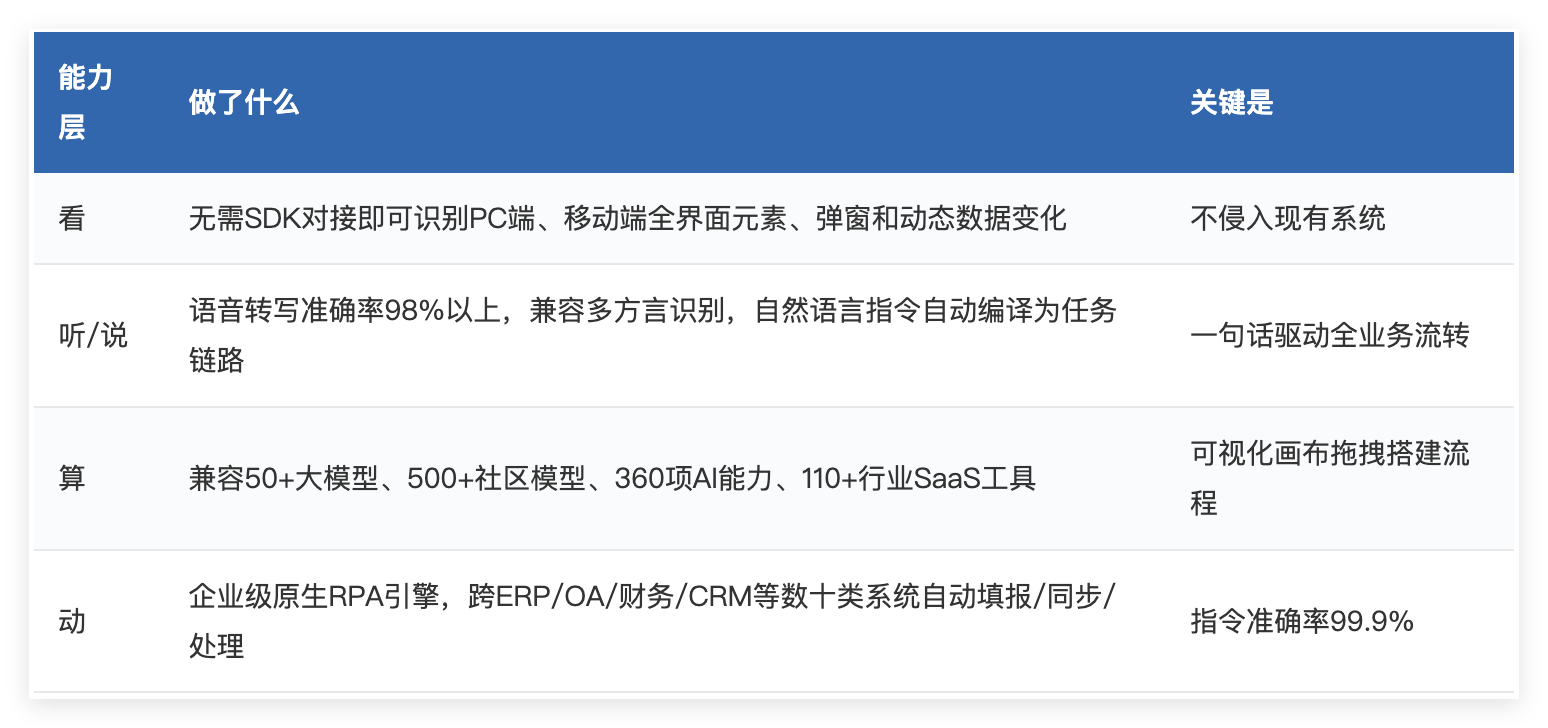
On June 4, DeepBlue Technology signed an agreement with China Mobile—Mobile Cloud Phone will be equipped with the DeepAgent intelligent agent system. The core selling point of this system is "OPC lightweight single-person digital transformation," which in plain language means: one person coordinates, a group of AI agents execute, without changing systems, writing code, or hiring new staff.

There are a few things worth taking a serious look at from a technical perspective:


Already operational scenario data: Energy contract review compressed from 8 hours to 15 minutes (80% efficiency improvement), industry report generation efficiency increased by 200%, overall operational costs can be reduced by up to 95%.

Interestingly, its pricing model is such that the SaaS out-of-the-box version targets small and medium-sized enterprises, while the proprietary cloud and on-premises private deployment target government, enterprises, and financial institutions. This is essentially the same logic as Huawei Cloud's "hybrid cloud + public cloud dual-track" approach: large clients require compliance, while small clients prioritize speed.

Look at the three clues together

Bain report, Huawei Cloud INSPIRE, DeepBlue DeepAgent — these events occurred in the same week, but it is not a coincidence. Pieced together, they reveal three real signals of enterprise AI implementation in June 2026:

Signal 1: ROI anxiety is spreading from the CIO level to the CFO level. Bain's data essentially confirms a judgment: the AI investment returns for most companies have not reached the figures stated in their budgets. And the 2027 financial statements will bring this issue to the forefront. Companies that can survive that round of scrutiny are likely those that have already begun to separate "actual savings" from "expected savings" in their accounting.

Signal 2: The competitive focus of domestic manufacturers has shifted from "who has the bigger model" to "who can make AI run specific businesses". Huawei Cloud is not competing for total Token rankings, but instead focuses on pathological diagnosis and building embodied intelligence development platforms. DeepBlue is not boasting about how powerful its multimodal capabilities are, but telling you that contract review has been reduced from 8 hours to 15 minutes. This shift is healthy — after listening to model parameters for over a year, enterprise clients now want to hear "how many FTEs can I save".

Signal 3: The barrier to AI adoption for SMEs is lowering, but the cost of choice is rising. Lightweight solutions like DeepAgent, which require "no system replacement, no coding," are precisely targeting SMEs. Huawei Cloud's Smart Orchard is doing the same thing—it is designed as an Agent service rather than a human service. But the problem is that there are now too many options: Huawei, DeepBlue, Alibaba Wukong, ByteDance Agent Plan, Tencent WorkBuddy—SME CIOs are not facing "no solution available," but rather "not knowing which solution will still be usable six months from now."

Practical operational suggestions for enterprise digital leaders

First, while there is still time, separate the "actual ROI" and "expected ROI" of your company's AI projects in your statistics. The most dangerous figure in Bain's data is not the 40% that failed to meet targets, but the 44% of companies using expected values to support their next round of investment. If your finance department is doing the same, make it clear now.

Second, before selecting an AI agent solution, first conduct a data accessibility audit. The core conclusion of Bain's diagnosis—that the bottleneck lies in the data pipeline, not the model—has been acknowledged by both Huawei Cloud and DeepBlue's product positioning. Regardless of who you choose, first ask whether your existing ERP/CRM/OA systems can allow the AI to read the required data. If they cannot, switching models will be useless.

Third, small and medium-sized enterprises can consider the path of "lightweight + small-scenario entry." What makes DeepBlue's OPC model interesting is that it doesn't require you to change your system. If you are a manufacturing company with annual revenues ranging from tens of millions to hundreds of millions, starting with single-point scenarios like contract review, invoice processing, and report generation can yield results in three months, which is more reliable than directly adopting an "AI middle platform."

关于我们

​我们致力于帮助中小企业实现数字化转型,我们的团队由一群充满激情和创新思维的专业人士组成,他们具备丰富的行业经验和技术专长。

扫一扫获取顾问以及手册

归档
Sign in to leave a comment
NVIDIA handed chip design over to AI, and Huawei Cloud said tokens should be industrialized—this same week, the second half of enterprise AI officially kicked off.