On May 14, Anthropic released an announcement that didn't attract much attention at the time. But now, with only 4 days left until June 15, I've gone through the full details of the changes and found that the impact on enterprise users is greater than expected—especially for Enterprise Standard seats, where the monthly quota for Agent SDK is $0.
On the same day, OpenAI announced that new enterprise customers can use Codex for free for two months. Not a coincidence.
What exactly has changed
Simply put: Previously, your Claude subscription covered all usage—chat, code, Agent SDK, and headless mode—all in one pool. After June 15, the Agent SDK and claude -p (headless command) are separated from the subscription pool and moved to a separate monthly USD credit pool, billed at standard API pricing.
Only automated scenarios are affected — Agent SDK, headless commands, GitHub Actions, and third-party IDE plugins. Manually typing code in the terminal or IDE (Claude Code TUI) or chatting on claude.ai are not affected.
Before June 15, one pool covers everything; after June 15, interaction/Agent are calculated separately.
Agent SDK quotas by tier
I have compiled the monthly Agent SDK quotas for each subscription tier into a table. There is one detail that is particularly easy to overlook—I have highlighted it in bold.
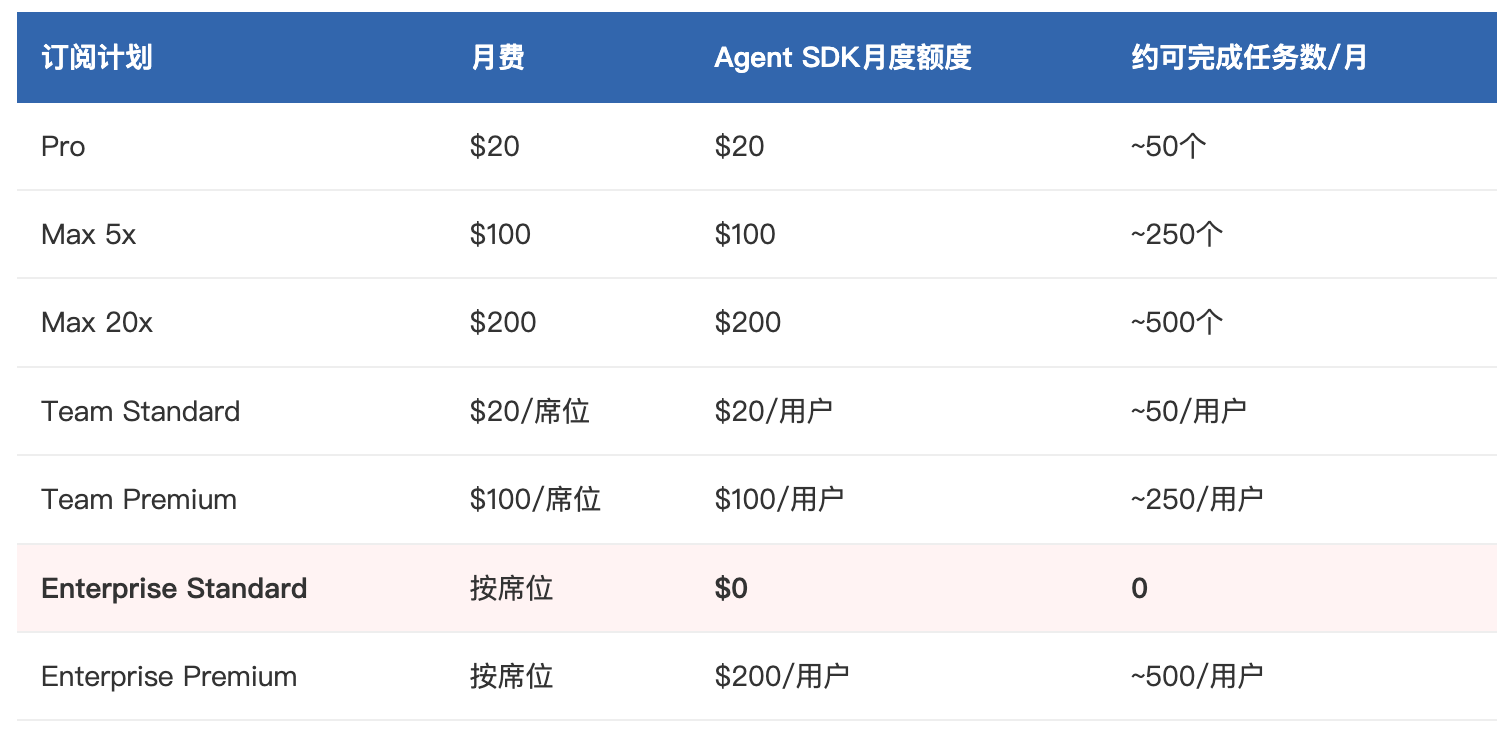
The issue of Enterprise Standard seats having a $0 quota is, in my opinion, underestimated. Many enterprises assume that purchasing Enterprise means "all-inclusive," but after June 15, Agent SDK requests on Standard seats will directly fail—not slow down, but fail. Unless you upgrade to Premium or separately enable usage credits for pay-as-you-go billing.
One more thing: the quota is allocated per user and cannot be combined across team members. If your team has 10 people, each with a $20 quota, it does not mean you can let one person use $200. Shared CI/CD pipelines must be migrated to direct API Key billing.
OpenAI acts on the same day
On the same day Anthropic released its announcement on May 14, Sam Altman announced that new enterprise customers can use Codex for free for two months. The timing is too coincidental.
I checked the comparison:
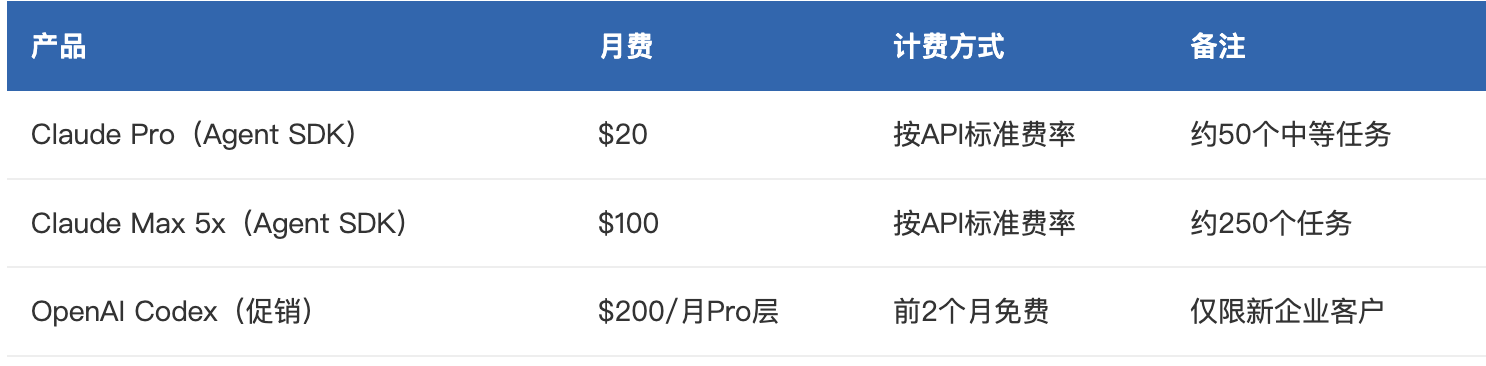
To put it bluntly, OpenAI is playing the "trial period talent grab" — first pulling you in with two months free, then charging you the same API rates later. Anthropic is playing the "pay-as-you-go for more transparency" — subscriptions and automation are billed separately, so don't assume everything is all-inclusive anymore.
But there is a deeper signal: ServiceNow and Uber have already exhausted their entire 2026 AI token budget in advance. The "all-inclusive" AI subscription model is unsustainable in the Agent era. Once AI agents start running, token consumption is on a completely different scale from human usage—an agent might make thousands of API calls in a single night, more than you would use in a month of regular chatting.
$0.075 The single-run cost of a moderately complex Agent task (10K input + 3K output tokens) under the standard Sonnet 4.6 pricing
Three substantive impacts on enterprise AI budgets
I recently chatted with a few friends working on enterprise AI deployment, and we all share the same feeling: AI budgets are getting harder to calculate. Previously, you just bought a subscription and that was it. Now that agents are running, costs depend entirely on usage. Let me list the three most practical impacts.
First, if you are using a Claude Enterprise Standard seat, you must make a decision before June 15. Either upgrade to Premium ($200/user with $200 credit), or migrate to direct API Key billing. Don't wait until Agent requests suddenly fail to find out.
Second, Prompt Caching is currently the most cost-effective optimization method. The cost of input tokens with cache hits is reduced to 0.1 times—saving 90%. If you have agent workloads that repeatedly send the same system prompts or file contexts, this is the most important thing to do before June 15. No need to change business logic, just configuration-level adjustments.
Third, when budgeting for AI agent deployment, don't calculate based on the "subscription + seat" model; estimate based on "API call volume." An agent running 50 medium-complexity tasks per day costs roughly $112 (Sonnet 4.6) to $187 (Opus 4.7) per month. Have 10 such agents? Monthly costs directly exceed $1,000+. And that's not even counting complex tasks.
CIO's Checklist
There are only 4 days left until June 15. I recommend that enterprise IT teams perform the following checks:
1. Check your Claude subscription tier and seat type clearly. The $0 quota for Standard seats is the easiest pitfall to fall into.
2. Calculate the current actual monthly usage of the Agent SDK and claude -p. If it has already exceeded $200/user, it is more cost-effective to directly use API Key billing, which is also what Anthropic officially recommends.
3. For those using Claude GitHub Actions in CI/CD pipelines, quotas cannot be combined and must be migrated to API Key.
4. Enable Prompt Caching before June 15. This is the lowest-cost, highest-leverage optimization.
5. Evaluate whether the 2-month free trial of OpenAI Codex is worth switching to. But remember: the API rates after the trial period will not be cheaper than Anthropic's.
Industry signal: AI agent billing is shifting from a "subscription model" to a "usage-based model." This is not a choice unique to Anthropic—ServiceNow and Salesforce are also adjusting their pricing models for AI features. CIOs need to shift their AI budget logic from "software licensing fees" to "cloud infrastructure usage fees."
