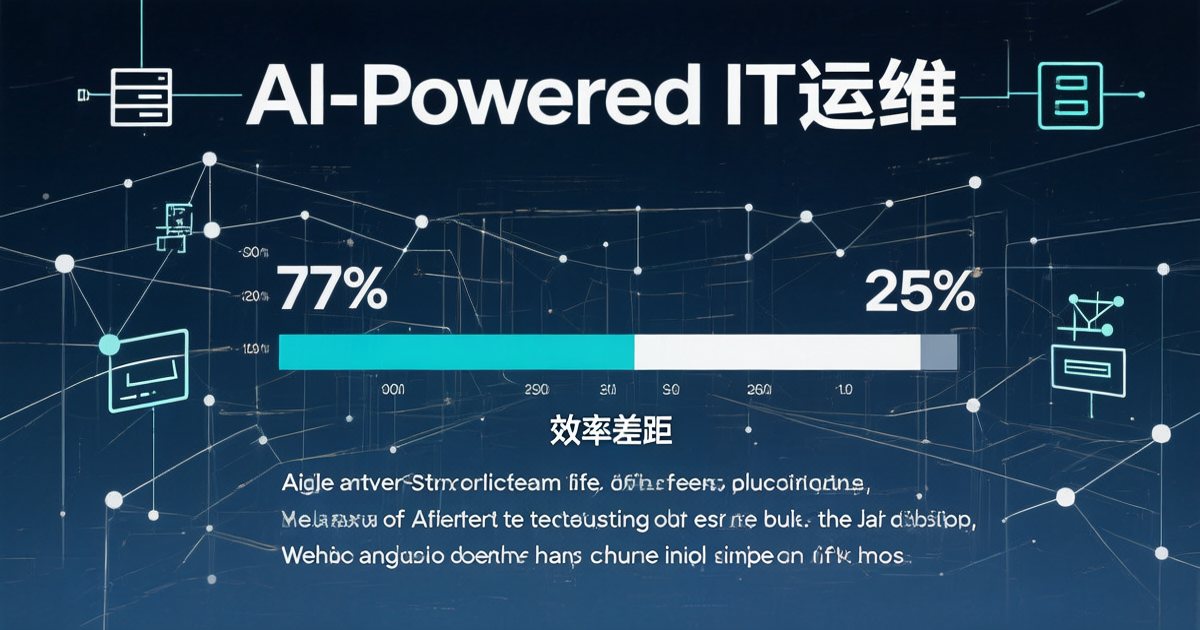
52% "readiness gap" 77% executives want to accelerate vs 25% believe infrastructure is ready
IBM Research Key Data
77% hope to accelerate AI implementation, 25% believe infrastructure is ready, 64% believe AI success depends on personnel adoption, 80% reduction in fault repair time
What Does This Gap Mean
Pan Jun, General Manager of IBM China Technical Services, shared a set of data: nearly 80% of corporate executives hope to accelerate the implementation of AI applications, but only a quarter believe their own IT systems can support this ambition.
This 52% gap is not a budget issue, nor a technical issue, but an architectural issue. Many enterprises' IT infrastructure was designed a decade ago—it can still handle running ERP and OA systems, but when faced with the computing power demands and network requirements of generative AI, it's like asking an old ox to pull a sports car.
A concrete example: a thousand-card GPU cluster requires thousands of high-speed cables, and network interfaces are evolving from 400G and 800G toward even higher rates, making traditional cabling methods completely inadequate. The per-rack power of high-performance GPU clusters has surged from the traditional 5-10 kilowatts to over 30 kilowatts, posing challenges in both power supply and heat dissipation.
Three Generations of Evolution in AI-Driven IT Operations
Traditional mode: manual inspections, passive response, handling after failures occur; Automation: script-driven, preset responses, reduced manual intervention; Agentic AI: autonomous reasoning, multi-agent collaboration, self-healing of failures
"1-5-10" Intelligent Closed Loop: Not Just a Gimmick
This goal proposed by IBM is worth a closer look: perceive anomalies in 1 minute, locate root causes in 5 minutes, and close the loop with repairs in 10 minutes. Supporting this goal are AI agents, standardized protocols (such as MCP), and a preset "authorized action library."
Pan Jun mentioned that among the more than 4 million IT assets they manage globally, the automated response and handling rate for Call Home device alerts has reached 91%. With the help of AI agent assistants, junior engineers can complete expert-level tasks, and problem resolution time has been reduced by approximately 32%.
The core value of AI lies in enhancing professional capabilities, rather than simply replacing human labor. It frees up repetitive work, allowing operations and maintenance personnel to shift toward areas of greater business value.
What Small and Medium Enterprises Can Learn
Large enterprises' solutions may not necessarily suit small and medium-sized businesses, but there are a few approaches worth referencing:
First, advance in layers. Don't think about "AI-First" reconstruction from the very beginning. Start with breakthroughs at single points, such as using AI for log analysis or alert compression. IBM data shows that resource utilization improved from 65% to 89%, driven precisely by AI-powered capacity planning and dynamic scheduling.
Second, value the data foundation. IBM Support Insights can monitor over 4 million assets and 1.5 million active vulnerabilities, capabilities built on solid data collection and governance. Without good data, even the most advanced AI is a castle in the air.
Third, reserve space for switching. The recent moves by the Ministry of Industry and Information Technology are worth attention: it is about to release "AI+" high-value scenarios, and ten departments will jointly regulate AI ethics governance. Use services that have already passed domestic compliance reviews, while reserving model switching interfaces to leave room for subsequent adjustments.
Back to that 52% gap. For small and medium-sized enterprises, this is both a challenge and an opportunity: while large enterprises are still struggling with architectural restructuring, perhaps you can start using AI in a lighter way first.
