1.0 Problem Statement: The Hidden Impact of Decimal Measurement Units on Inventory and Production Costs
In a complex production and supply chain environment, seemingly negligible calculation errors in material consumption, especially those involving decimal measurement units, can trigger a chain reaction, posing significant challenges to inventory accuracy, production planning, and even cost control. When the system allows material requirements to exist in decimal form, enterprises will face a series of operational risks that are difficult to detect but have serious consequences.
These risks stem from the mismatch between material requirement calculations and actual supply units. For example, the cumulative material demand from multiple small-batch production orders might be 10.7 units, but during replenishment or material picking, the system or operators may round it down to 10 units, leading to material shortages. Over time, such minor deviations can erode a company's operational efficiency. Core business risks include:
- Material shortage and production interruption: Insufficient material supply due to rounding down is the direct cause of unplanned production line shutdowns, severely impacting delivery commitments and customer satisfaction.
- Inventory data distortion: Persistent discrepancies between system records and physical inventory lead to a loss of credibility in inventory data, complicating and making inefficient procurement decisions and inventory counts.
- Inaccurate cost accounting: Inaccurate recording of material consumption directly affects the accuracy of product cost accounting, which may lead to incorrect pricing strategies and profit assessments.
However, Odoo 19 empowers enterprises to shift from reactive problem-solving to proactive operational design, embedding supply chain integrity directly into the core logic of the system.
2.0 Odoo 19 Core Solution: Achieving Material Management Certainty Through Refined Configuration
Odoo 19's material management functionality goes beyond basic inventory tracking, offering a powerful set of configuration tools designed to embed a company's business rules directly into system logic. The core idea of this approach is to transform ambiguous areas in material usage into clear, executable system instructions, thereby achieving operational certainty.
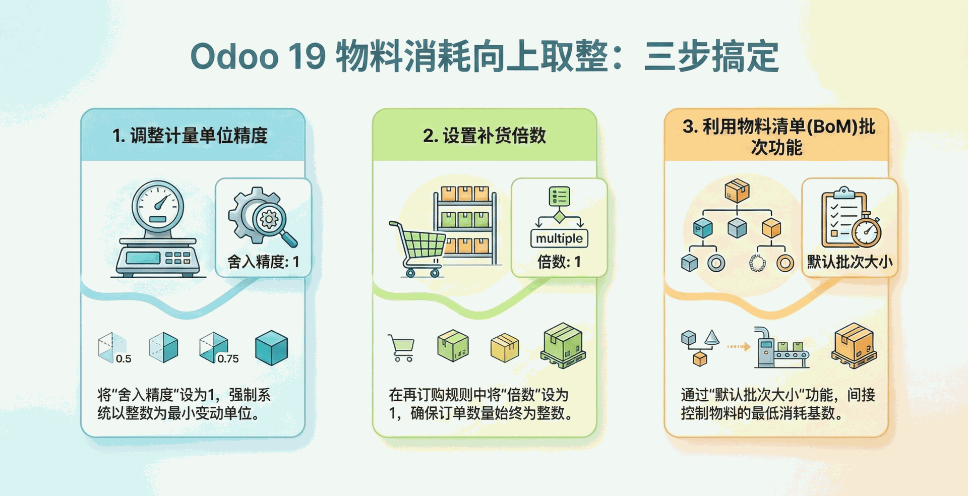
To address issues caused by decimal material consumption, Odoo 19 provides three core configuration strategies that together build a progressively layered defense system: starting with data integrity at the unit of measure level, extending to process control at the replenishment transaction level, and ultimately implementing forward-looking planning at the production source.
- Adjust measurement unit precision: Ensure all calculations are based on integer logic from the data source.
- Set restock multiplier: Establish an intelligent error-proofing mechanism in the supply chain to ensure the integrity of supply units.
- Use default batch of bill of materials: Standardize consumption benchmarks during the production planning phase to reduce the generation of fractional demand.
The following chapters will delve into the technical implementation of each strategy, with a focus on the specific business value they bring to enterprises. Let us first analyze the most fundamental aspect of these strategies: strengthening data integrity by adjusting the precision of measurement units.
3.0 Specific Configuration Strategy and Its Business Value
3.1 Adjusting Measurement Unit Precision: A Root-Level Solution for Strengthening the Data Foundation
Technical Configuration: The configuration path for this strategy is Inventory > Configuration > Units of Measure. In this interface, find the unit of measure (e.g., "unit") used by the material to be controlled, and set its Rounding Precision parameter to 1.00000.
Business Value Analysis: This setting establishes the integer as the smallest indivisible unit. Therefore, any demand with decimals generated by system calculations (e.g., 1.2 units) will be automatically rounded up to the next integer (i.e., 2 units) by the system logic, fundamentally preventing demand deficits. This action establishes a unified and reliable "single source of truth" for all inventory-related data, ensuring data accuracy from the source.
3.2 Set Replenishment Multiplier: Intelligent Error-Proofing Mechanism to Ensure Supply Integrity
Technical Configuration: In the product's reordering rules (path: Inventory > Operations > Replenishment), set the Multiple parameter to 1.
Strategic Impact Assessment: This setting goes beyond simple business recommendations and becomes a mandatory system policy. It programmatically prevents procurement or production planners from creating orders with non-standard quantities, thereby reducing human error and ensuring compliance with established supply chain protocols (e.g., purchasing only by full cases). Even when multiple production orders exist in the system that cumulatively generate fractional demand, the replenishment engine automatically rounds up to the nearest integer multiple when calculating total demand. It robustly safeguards the integrity of material supply and serves as a critical defense against fractional gaps caused by demand aggregation.
3.3 Utilizing Material List Default Batches: Forward-looking Planning for Standardized Production Consumption
Technical Configuration: This is a new feature in Odoo 19 added to the Manufacturing > Products > Bill of Materials (BoM) module. By setting a Default Batch Size, you can preset a standard suggested production quantity for manufacturing orders.
Business Value Analysis: This function provides forward-looking indirect control over material consumption. By setting a standard production batch size (for example, a minimum production batch of 100 units), enterprises can regulate the minimum material consumption base for a single production run at the source. This helps align production planning with procurement logic (e.g., purchasing by full packages or full cases), thereby minimizing the probability of generating sporadic or fractional material requirements as early as the planning stage. It promotes synergy between production and supply, making operational processes more standardized.
These configuration strategies work together to build a powerful framework that systematically eliminates decimal deviations throughout the entire process from initial data definition to final production execution, thereby ensuring end-to-end inventory integrity.
4.0 Comprehensive Business Revenue: Transformation from System Configuration to Enterprise Benefits
Although the above technical configurations are straightforward in themselves, their true value lies in the cumulative positive impact on enterprise operational efficiency and financial health. Applying these Odoo 19 features in combination can transform the advantages of system configuration into tangible business benefits.
- Significantly improve inventory accuracy By eliminating decimal calculation errors, the inventory data in the system will be highly consistent with the physical inventory in the warehouse. This not only simplifies inventory counting work but, more importantly, provides reliable data support for procurement and production planning, avoiding erroneous decisions caused by inaccurate data.
- Effectively avoid the risk of production interruption The mandatory rounding-up of measurement units and replenishment orders generated in integer multiples fundamentally eliminate supply shortages caused by material calculation deviations. This means that the production line can obtain a continuous and complete supply of materials, thereby ensuring the smooth execution of production plans and avoiding costly downtime risks.
- Deeply optimize procurement and manufacturing costs Standardized order batch sizes and material consumption make procurement and production processes more standardized and predictable. This not only helps secure better prices through bulk purchasing but also reduces additional management and manufacturing costs caused by urgent procurement and small-batch production, ultimately achieving effective cost control.
In Odoo 19, these refined settings are not simple technical adjustments; they are strategic levers for enterprises to elevate inventory management from passive record-keeping to active value creation.
5.0 Next Steps
To ensure the success and impact of the plan's deployment, we recommend adopting the following phased implementation approach:
Phase 1: Target Identification and Priority Ranking Organize a cross-departmental (production, procurement, inventory) special meeting to jointly identify key materials that are most sensitive to small quantity consumption or whose shortage would cause the greatest impact. Use these materials as the first batch of pilot objects for applying this configuration plan.
Phase 2: Differentiated Application and Strategy Design Based on the workshop results, conduct an in-depth analysis of how to configure differentiated replenishment rules according to the operational characteristics of different warehouses (e.g., transit warehouses next to production workshops versus central raw material warehouses). This will ensure that the implementation of the plan accurately matches actual business needs and maximizes benefits.
