On June 2, two events took place simultaneously at the Beijing National Convention Center.
In the morning, the 8th Beijing Cybersecurity Conference (BCS 2026) opened, and Qi Xiangdong, chairman of Qi An Xin, said a sentence on stage: "Attacks have become extremely powerful, rendering traditional defenses virtually useless."
In the same building, the 2026 China AI Agent Leaderboard is being unveiled—AI agents from over 100 enterprises across more than 20 industries have been selected, spanning from government affairs to manufacturing, and from finance to agriculture and animal husbandry, painting a panoramic picture of AI agent deployment in China.
On one side are security alarms, on the other is the accelerated release of rankings. When these two things are viewed together, what enterprise AI is experiencing becomes clear.
27 Seconds — Attacks Enter the "Industrial Age"
BYD CISO Luo Xiaoping gave a figure at BCS: the release of the Mythos large model marks that the time for cyberattacks to breach defenses has been compressed to 27 seconds.
What does 27 seconds mean? It’s the time it takes you to open a SAP interface and log in—by then, the attack is already complete. Luo Xiaoping’s exact words were: attacks have entered the “industrial age,” but defenses are still stuck in the “manual age.”
齊向東在主旨演講裡把這事講得更透。他提了"三個攻防失衡":
Attacker
Efficient, automated, and accessible to everyone — attack tools no longer require a PhD to use.
Defender
Static defense cannot outpace dynamic attacks, manual response cannot withstand high-frequency attacks, and isolated points cannot block global attacks.
Qi Xiangdong's proposed solution is a "trinity" collaborative defense system—the bottom layer consists of AI-powered security products ("muscles" and "hands and feet"), the middle layer is the security intelligent agent responsible for operational coordination ("nerves" and "torso"), and the top layer is the large model foundation for intelligence sharing and decision-making ("wisdom" and "brain").
The interesting part of this architecture is: it is essentially an enterprise AI governance model, not just a security product. The large model is responsible for cognition, the agent is responsible for execution, and the underlying tools are responsible for implementation—this is almost identical in structure to the "AI digital employee management system" that enterprises are building.
Luo Xiaoping put it more directly: the industry's common ailment is "blind faith in algorithms while ignoring data." BYD itself is building a security data lake foundation called "iDi Dog" — first breaking through data silos, then letting AI security agents run on top of it.
This way of thinking applies to any enterprise implementing AI: Don't first think about how to use AI to manage business; first think about whether your data can be understood by AI.
In the same building, over 100 AI agents are receiving awards
On the other side of the BCS venue, the 2026 China AI Agent Navigator List was unveiled. Jointly initiated by the Internet Society of China and the Artificial Intelligence Industry Alliance (AIIA), the four major tracks cover all scenarios from security to manufacturing:
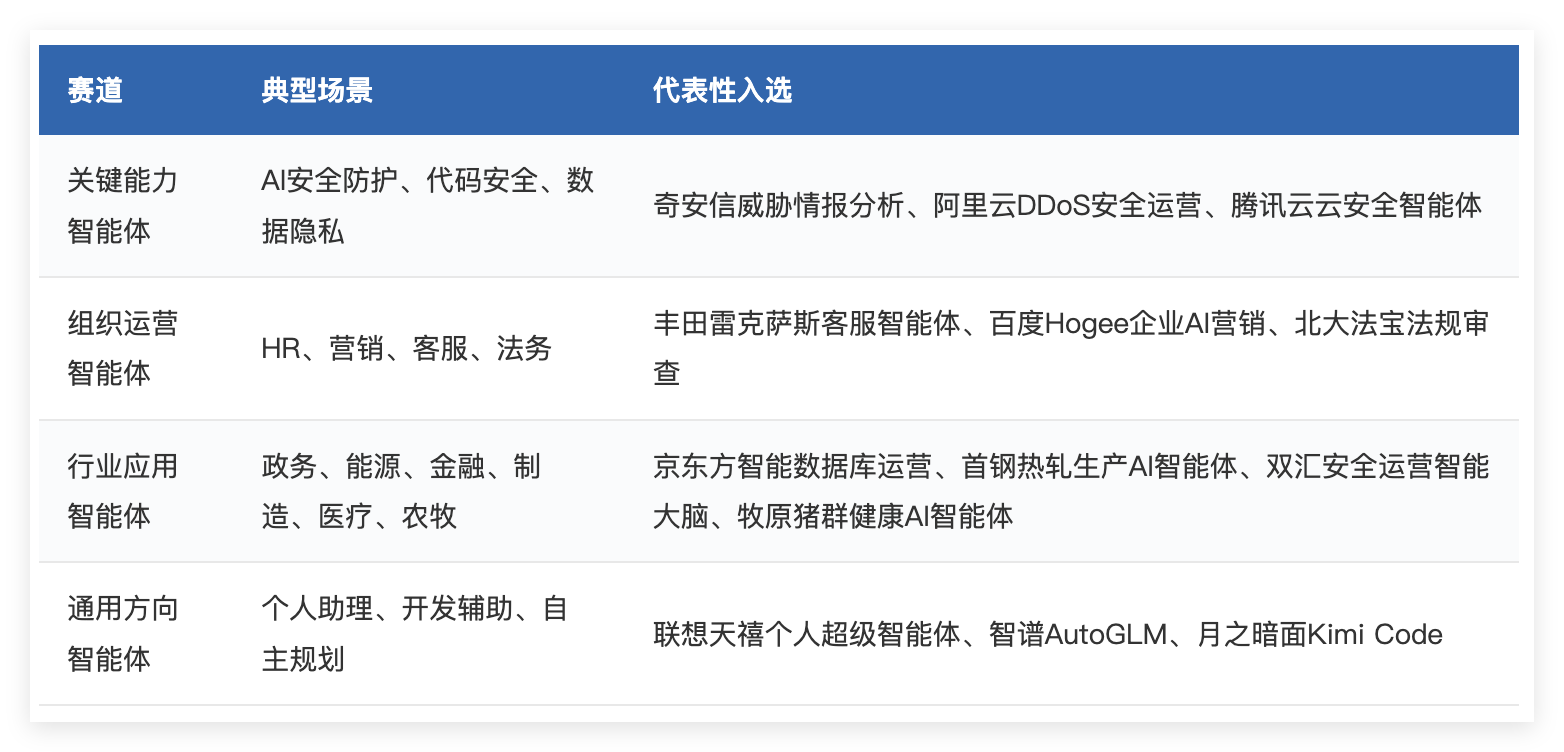
The distribution of these 100+ selected companies tells you one thing: AI agents are no longer a toy exclusive to tech companies. Muyuan in pig farming, Shuanghui in ham production, Shougang in steelmaking, and BOE in panel manufacturing—traditional industries are using AI agents in ways that are more practical than many tech companies.
The selection criteria have also changed this time — no longer focusing only on technical indicators, but rather "placing equal emphasis on application value and safety controllability". Specifically, three points are considered: the depth of implementation and sustained operational capability of intelligent agents in real business scenarios, compliance indicators such as data security and permission control, as well as technological advancement, application effectiveness, and replicability.
This standard change itself is a signal: for AI agents in 2026, people no longer care about "whether they can be built," but rather about "how long they have been running after deployment, whether they are safe, and whether other companies can copy the playbook."
BlueShield's Three Products: The "Safety Manual" for Government and Enterprise AI
On the same day as BCS, Lanxin also held its own press conference at the National Convention Center. It launched three products:
LanEcho Listening Blue AI Recording Card — a 2.88mm-thick AI hardware for government and enterprise use, with data staying within the domain, full-link encryption, bone-conduction call recording, and offline storage.
LanSphere Blue Domain Intelligent Agent Platform — claimed to be "China's first fine-grained permission-controlled intelligent agent development platform for government and enterprise." 100% Xinchuang compliant, reducing the intelligent agent development cycle from 2 weeks to 4 hours. Consistent with Qi Xiangdong's "trinity" security system logic: security is not an add-on feature, but the foundation of AI infrastructure.
KnowAct AI Super Assistant — On mobile, it acts as an "information triage desk," prioritizing urgent matters; on desktop, it can autonomously operate business systems in a secure local virtual machine, processing at 30 times the efficiency of manual work.
Li Rongquan, CEO of Lanxin, said something quite accurate:
The explosion of large language models and Agent technology has completely ended the era of "digital transformation" in the past, and is now moving toward a new epoch driven by AI-native and driven by comprehensive intelligent reconstruction.
The term "digital transformation" is well used—over the past decade, many companies' digitalization simply moved paper-based processes into systems, without changing the processes, the organization, or the decision-making methods. AI-native does not mean "adding an AI button to old processes"; it means the processes themselves need to be rewritten.
What Enterprise CIOs Should Focus on Now
BCS and AI agent navigators made their debut on the same day, mutually illuminating a central theme: Enterprise AI implementation has moved from "whether to use it" to "how to use it safely."
幾點判斷:
First, security is no longer just the IT department's concern. When AI agents can directly operate ERP systems, approve purchase orders, and schedule production lines, security issues become business continuity issues. Qi Xiangdong's claim that "attacks break through defenses in 27 seconds" is not meant to scare people — if your AI procurement agent is manipulated, how many fake orders can be placed in 27 seconds?
Second, build the data foundation first, then deploy AI. BYD's approach is worth copying — first build the data lake "iDi Dog" to break down data silos, then introduce AI security agents. Luo Xiaoping's point that "blindly trusting algorithms while ignoring data" is a common industry ailment — if this problem isn't solved, even 100 AI agents won't be able to run.
Third, security must be planned together with AI, not retrofitted. Lanxin builds security into the underlying layers of AI hardware, while Qi Xiangdong divides security into three layers—"muscle, nerve, and brain"—both making the same point: enterprise AI must be secure by design. Retrofitted security solutions are useless in the AI era—by the time you discover a problem with an AI agent, the damage has already been done.
Fourth, when selecting AI agents, focus on "how long they can run" rather than "what they can do." It is no coincidence that "sustained operational capability" is placed first in the Navigator selection criteria. AI agents that can run demos are everywhere, but those that can run continuously for six months without issues are the real deal. When CIOs choose AI agent suppliers, they should not fixate on demos—instead, require at least one quarter of actual operational data.
On June 2nd, the two venues at the Beijing National Convention Center addressed different facets of the same issue: AI is accelerating within enterprises, but the braking system has yet to be installed.
